


Israel - Life World Library
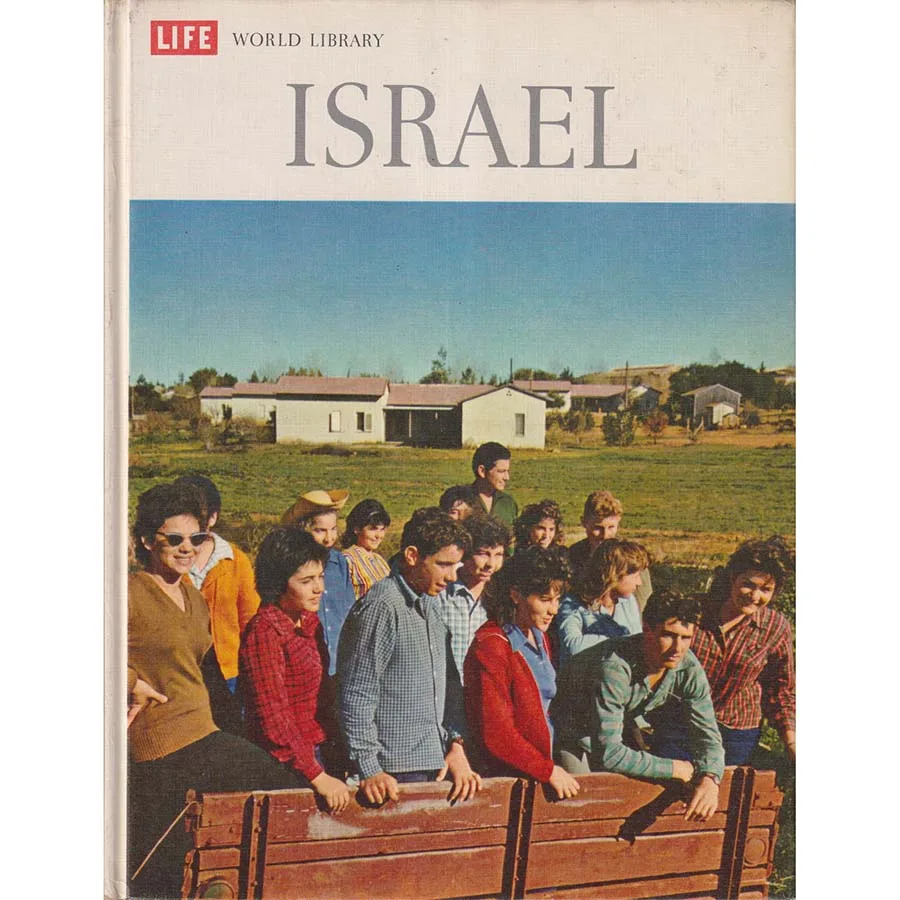
Publisher: Time-Life International
Format: Hardback
ISBN: none
Israel - Life World Library (1962) by Robert St. John – Time-Life International
ISBN: None
Condition: Good
Israel, 1962. A country only fourteen years old in its modern form, occupying a piece of land with several thousand years of history already attached to it and enough political, religious and historical significance to keep archaeologists, diplomats, theologians and newspaper editors permanently employed.
Published by Time-Life International as part of its ambitious Life World Library series, Robert St. John’s Israel is a fascinating period portrait of the country during its earliest decades of statehood.
And “period portrait” really is the important phrase here.
This is Israel before the Six-Day War of 1967.
Before the Yom Kippur War.
Before many of the borders, settlements, political arguments and diplomatic arrangements familiar from later decades had taken their modern form.
In 1962, the State of Israel had existed for less time than many of the cars photographed in this book would now spend awaiting restoration.
The country had been established in 1948 following the end of the British Mandate and the United Nations partition proposal, and had immediately fought a war with neighbouring Arab states.
Hundreds of thousands of Palestinian Arabs had been displaced during that conflict, while large numbers of Jewish refugees and immigrants were arriving from Europe, the Middle East and North Africa.
So from the beginning this was not exactly a nation enjoying a quiet administrative start-up period.
There were refugees.
Immigration camps.
Housing shortages.
Security concerns.
Water shortages.
Economic pressures.
Border tensions.
And the modest challenge of attempting to build functioning national institutions almost from scratch.
Yet by 1962 Israel was already creating cities, industries, farms, universities, infrastructure and a distinctive national identity at remarkable speed.
Time-Life naturally found plenty to photograph.
Kibbutzim.
New towns.
Desert agriculture.
Ports.
Factories.
Immigrant communities.
Markets.
Schools.
Ancient archaeological sites.
And enough serious-looking people standing beside irrigation equipment to reassure any 1960s reader that civilisation was moving firmly in the direction of progress.
Irrigation was particularly important.
Large areas of Israel are dry.
Very dry.
The sort of dry that makes a British hosepipe ban seem almost theatrical.
Water therefore became one of the central practical challenges of the young state, and agricultural development depended heavily on irrigation, conservation and major infrastructure projects.
Making the desert bloom became one of the great symbols of early Israeli nation-building.
It also provided excellent opportunities for photographs of pipes.
Mid-century publishers loved pipes.
Preferably large ones.
The kibbutz inevitably features prominently too.
These collective communities became one of the most recognisable images of early Israel: agriculture, shared labour, communal living and idealism mixed together under considerable quantities of sunshine.
To Western readers in the early 1960s, the kibbutzim seemed almost experimental.
Part farm.
Part village.
Part political philosophy.
Part place where everyone apparently knew how to repair a tractor.
Whatever one’s politics, they represented an extraordinary attempt to organise daily life differently.
Jerusalem, naturally, brings an entirely different scale of history.
Few cities can make a modern political dispute look recent.
Sacred to Judaism, Christianity and Islam, Jerusalem has been conquered, destroyed, rebuilt, besieged and argued over so many times that any ordinary municipal planning dispute must feel disappointingly modest.
In 1962 the city itself was divided.
West Jerusalem was under Israeli control.
East Jerusalem, including the Old City, was under Jordanian control.
The city would not come under unified Israeli control until the Six-Day War five years later.
That alone gives photographs and descriptions in this volume considerable historical interest.
A street scene is not merely an old street scene.
It belongs to a political geography that no longer exists in quite the same form.
Tel Aviv offers a very different Israel.
Modern.
Commercial.
Expanding.
Mediterranean.
And already developing the energy that would eventually make it one of the country’s great economic centres.
The architecture, traffic and clothing seen in early-1960s photographs now look wonderfully period.
There are cars that would today attract small crowds at classic vehicle shows.
Shopfronts that disappeared decades ago.
People wearing clothes that apparently required ironing before leaving the house.
And streets without anybody staring continuously at a phone.
Astonishing times.
Haifa supplies the port, industry and dramatic slopes of Mount Carmel.
The Negev supplies desert.
Galilee supplies landscapes heavy with both agricultural and biblical associations.
And almost everywhere, history sits inconveniently close to the surface.
Dig a hole for a new building and there is always the faint possibility somebody will discover another civilisation underneath.
This must make construction schedules interesting.
Robert St. John was particularly suited to writing the volume.
An American journalist and author, he wrote extensively about Israel and the Middle East and had spent significant time in the region.
His perspective gives the book the flavour of engaged contemporary reportage rather than detached encyclopedia writing.
That is particularly valuable now because this is not history reconstructed decades later.
The author is looking at Israel while these developments are actually happening.
Nobody knows what comes next.
There is no retrospective chapter saying:
“Things become significantly more complicated in 1967.”
The early state is presented as a present reality rather than a historical phase.
That absence of hindsight is one of the great pleasures of vintage books.
The people inside them are living towards a future we already know.
The Cold War forms part of the background as well.
Israel was navigating relations with the United States, Europe and the Soviet bloc while neighbouring Arab states were themselves caught up in competing alliances, nationalism and superpower rivalry.
The Middle East was already strategically important.
Oil helped.
The Suez Canal helped.
Several thousand years of unresolved history helped considerably.
The region had become one of those places where almost every international power had an opinion.
Usually several.
The early 1960s were also years of major immigration.
Jewish communities arrived from countries across Europe, North Africa and the Middle East, bringing different languages, traditions and cultural backgrounds.
Building a single national society from such diversity was an enormous undertaking.
Hebrew itself had undergone one of history’s most remarkable linguistic revivals, becoming the everyday language of a modern state after centuries in which it had been used primarily for religious and literary purposes.
Most countries merely have to organise schools.
Israel had to help rebuild a spoken language while doing it.
No pressure.
The book also inevitably reflects the viewpoints and assumptions of its period.
A publication from 1962 will not frame every issue in the language used today, and its treatment of Palestinians, neighbouring Arab countries, refugees, borders and national identity should be read with that historical context in mind.
That is not a defect so much as part of what makes the book valuable.
Old reference books reveal two histories simultaneously.
The history they describe.
And the history of how people described it.
Sometimes the most revealing thing is not what a book says, but what its writers assumed did not require explanation.
The photographs are therefore especially valuable.
Everyday scenes become social history.
A bus.
A café.
A farm.
A classroom.
A market.
A housing development.
Something photographed simply because it looked modern in 1962 may now look wonderfully ancient.
Meanwhile something considered ancient in 1962 was probably already several thousand years old and has barely noticed the difference.
This creates an unusual visual experience.
A brand-new apartment block may now be historically interesting.
A Roman ruin remains a Roman ruin.
History is unfair like that.
As with other volumes in the Life World Library, the physical book belongs to an era when learning about the world required furniture.
These books were designed to be substantial.
You placed them on shelves.
Possibly beside a globe.
Perhaps near an atlas.
And gradually created the impression that international affairs were under control.
Own enough volumes and visitors might assume you had once worked for the diplomatic service.
Whether you could actually locate every country without consulting the index was entirely secondary.
Today, Israel can be read on several levels at once: modern Israeli history, Middle Eastern politics, immigration, social history, agriculture, geography, religion and vintage photography.
And because the country has changed so dramatically since 1962, the book has become far more historically interesting than an ordinary contemporary reference work.
It captures Israel before many of the events now regarded as defining moments in its history.
Before 1967.
Before 1973.
Before the peace agreements with Egypt and Jordan.
Before modern high-tech Israel.
Before Tel Aviv acquired its contemporary skyline.
Before almost everything became instantly searchable online and every political disagreement acquired several thousand comments underneath it.
Obviously, this is not a modern guide to Israel.
Do not use it for border information.
Do not rely on its population statistics.
Do not assume transport routes remain unchanged.
And if it recommends a hotel telephone number, perhaps resist the temptation to ring it.
But as a snapshot of Israel during the formative years of the state, it is genuinely fascinating.
Condition: Good. A vintage copy showing the normal signs of age and previous ownership expected from a book published in 1962, but remaining in good overall condition and perfectly suitable for reading, collecting or placing conspicuously beside an atlas while appearing to contemplate several thousand years of Middle Eastern history.
An excellent addition to a collection of Israeli history, Middle Eastern studies, Time-Life books, vintage geography, Cold War material or mid-century photography.
It is also ideal for anyone who enjoys old reference books precisely because the confident present they describe has since turned into a very complicated past.
Sold by Crappy Old Books, where the books may be old, the maps may require updating, and absolutely no attempt will be made to settle the Middle East in the item description.
Keep browsing: See more Travel books Other books by Robert St John
